
32 → 95 Mobile performance
The Billboard Trailer Fleet Whose Website Weighed 17 MB, Rebuilt as a Store You Can Book From Your Phone
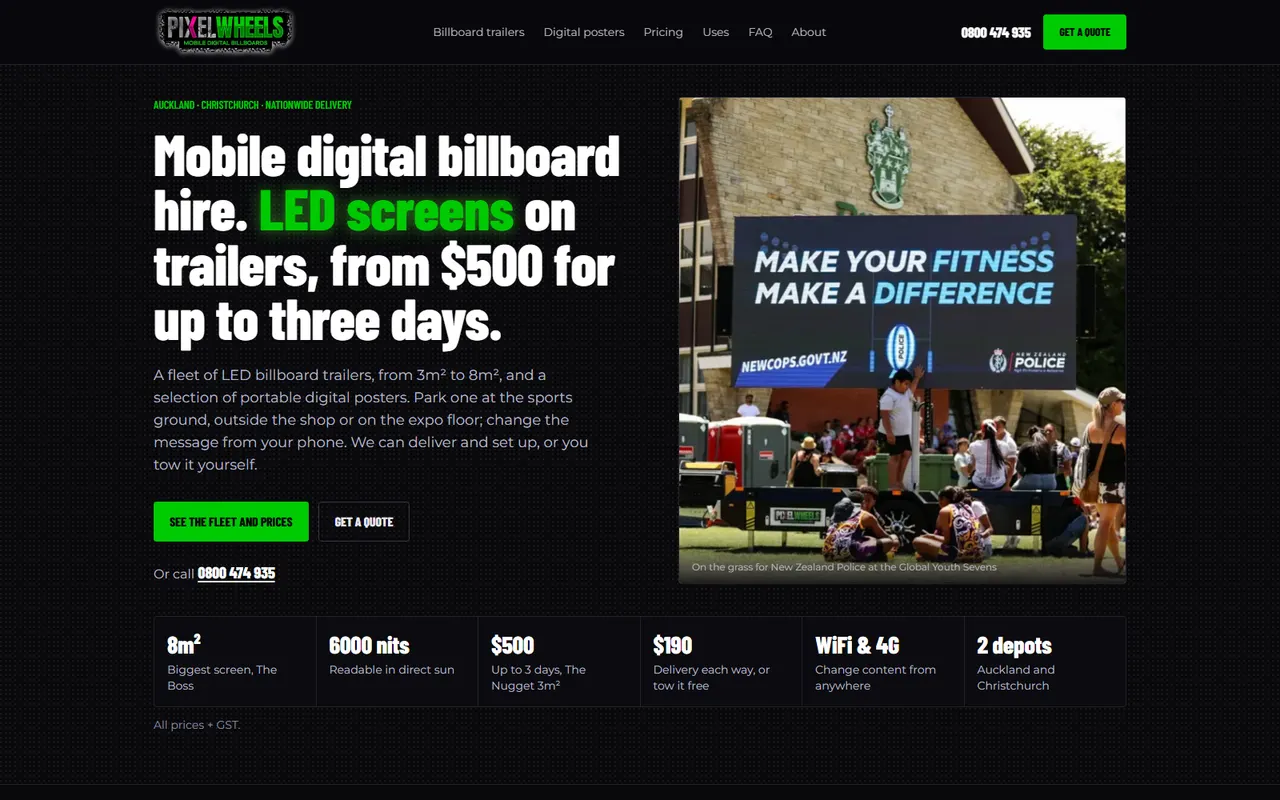
PixelWheels hire LED billboard trailers and digital posters out of Auckland and Christchurch. Their WordPress site handed every enquiry to a rental plugin, took 12.6 seconds to paint on a phone and scored 32 on mobile. We rebuilt it as a Next.js booking store: pick a screen, see the dates that are free, pay by card, done. Old addresses redirect, email is untouched, and the owner reads his bookings in a one-page admin.
32 → 95
Mobile performance
17 MB → 0.9 MB
Page weight
12.6s → 1.0s
Largest paint
> THE PROBLEM
The old site was WordPress with a page builder and a rental plugin bolted on. Every "Get a Quote" button sent people to the plugin’s product list, which loaded 17 MB and painted its largest element after 12.6 seconds on a phone. PageSpeed scored it 32 on mobile and 37 on desktop.
The sitemap held 27 URLs, 22 of them plugin plumbing, plus a sample page and a hello-world post. The domain ranked for two keywords. A separate landing page carried the Google Ads tag, but every button on it led back to the same plugin list, so there was no form anywhere a customer could fill in.
Bookings depended on a third-party rental service with its own login, its own fees and no view of what was booked without signing in. The owner wanted customers to see availability and pay on the spot, and to read his bookings without a second system.
> WHAT WE BUILT
We read the old site and the plugin’s product list into a research file (units, sizes, prices, add-ons, delivery, depots, the 19 site images and the gallery), then built a Next.js 16 site around how the fleet is actually hired: a page per unit, a page per city, pricing, uses, FAQ and about.
The store is ours, not a plugin. Each unit has a booking page with a calendar that greys out dates already taken, add-ons, insurance, and delivery or depot pickup. Payment is Stripe Checkout with the booking reference in the metadata; the webhook marks the booking paid and sends two emails, one to the customer and one to the owner. Without Stripe keys the booking is saved as requested and the emails still go, so the store worked the day it was deployed and the payments followed.
A one-page admin behind a password lists bookings with a CSV download, and lets the owner block dates per unit for jobs booked elsewhere, servicing or his own use. Existing bookings from the old service went in as blocked dates rather than being re-entered.
The switch moved the DNS to a Cloudflare zone we hold, with the Microsoft 365 mail records, the marketing-tool records and the Ads landing page carried across record for record and compared against the live answers before the nameservers changed. Old WordPress and plugin addresses redirect to their new pages.
TECH STACK:
> THE RESULTS
- Mobile performance 32 to 95; largest paint 12.6 seconds to 1.0 second; page weight 17 MB to 929 KB, measured on the live domain
- Lighthouse SEO and accessibility both 100 on the home page
- 23 pages in the sitemap, every one a page a customer might want, in place of 27 URLs of plugin plumbing
- Bookings paid by card on the site; confirmation to customer and owner inside a minute of payment
- Domain and email switched with no downtime: the old site served until the nameservers answered, the new site took over with a certificate already issued
- Owner reads every booking and blocks dates himself, with no third-party rental account to sign in to
The store works before the payments do. A booking site that cannot take a booking until the client’s payment account is approved is a site that sits dark. This one saves the booking as a request and emails both sides when no payment keys are set, then switches to card payment the moment the keys arrive. It was built and tested, taking requests, before the Stripe account was ready.
> QUESTIONS THIS PROJECT ANSWERS
> MORE CASE STUDIES
Glasshouse Consulting
Thirty Years of Research, Sitting on a WordPress Install Nobody Was Patching
READ CASE STUDY E-commerce / Squarespace RebuildThe Four Saucemen
Forty Products, Two Medals a Year, and a Shop That Took Eleven Seconds to Load on a Phone
READ CASE STUDY Leadership Consultancy / New BuildTalent Leadership Consultants
The Leadership Consultant Who Built a 12,000-Person Pipeline and Had a Google Site to Show for It
READ CASE STUDY> GOT A SIMILAR PROBLEM?
Tell us what's broken, slow, or missing. We'll scope it and send you a fixed quote.
Websites from $3,000 NZD. Stores and apps priced on scope.
> INITIATE CONTACT
Tell us what you need. You get a fixed quote back, usually within two working days, and no sales call unless you want one.
- 027 442 1031
Graham answers. Weekdays, Auckland hours.
- pressf@wastedmyult.com
What happens next: a reply within a working day, a fixed quote within two, and if it is a yes, your home page on a private link inside the first week.